Or, at least some folks who are putting up a battle against DWI charges in Minnesota. As reported by a local legal blog, a district court judge in Minneapolis is more or less foreshadowing that evidence from intoxilyzer results will be suppressed unless the manufacturer of the machine discloses its source code to the litigants. This has already been the rule for civil proceedings involving intoxilyzers, but this looks to be the first time the rule has impacted criminal proceedings in this state.
Of course, Minnesota is not the only state where this has been brought up in a defense motion to suppress. I understand that to date the manufacturer of this particular device has refused to grant access to the code, although I would welcome corrections to that understanding since I've only learned it through indirect sources.
Regardless of the facts or outcome of the particular battle between the DUI bar and the manufacturer (which in the end is not a battle we're well equipped to analyze other than as it deals with source code), the Cyberspace practitioner should already be well equipped to understand the fundamental pieces of this dispute. The manufacturer is undoubtedly claiming a right to maintain its source as a trade secret, and has so far only allowed its software to be distributed in object code (or lower) format that is not reviewable by human beings. That may well be its right under trade secret law (although we must leave open the possibility of arguments to be made on public policy grounds, or that somehow the manufacturer in this case waived its rights). Some, on the other hand, might argue that a business model based on proprietary code is not a wise one to follow where courts are more and more willing to demand openness. Could this manufacturer find its business model is ultimately a reason for a competitive manufacturer with a non-proprietary business model to step in and take business away? It all remains to be seen of course, and it's an interesting intersection between our world and another one.
Showing posts sorted by relevance for query "set us free". Sort by date Show all posts
Showing posts sorted by relevance for query "set us free". Sort by date Show all posts
Tuesday, December 11, 2007


Sunday, August 06, 2006
Program Two -- Transacting Business Over the Internet in the Asia-Pacific Rim
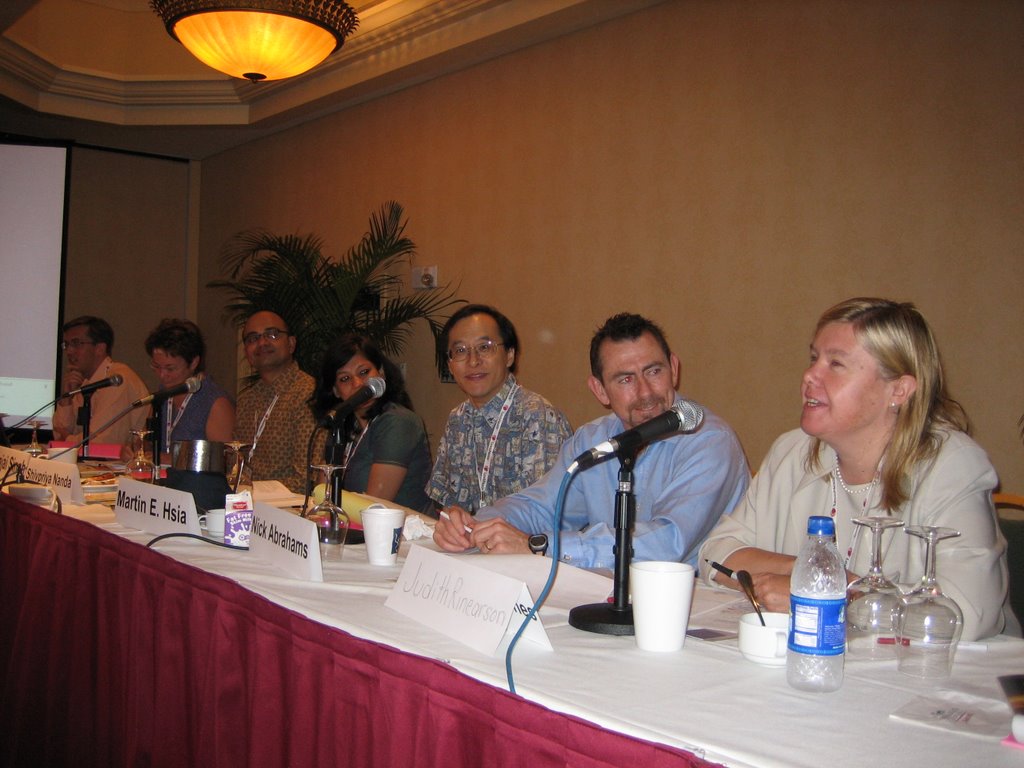
The primary program of the Committee opened at 7 AM Sunday morning -- Amazingly to a nice-sized crowd.
In the picture to the left: Scott Bain, Christina Kunz, Sajai Singh, Shivpriva Nanda, Martin Hsia, Nick Abrahams and Judith Rinearson
The program was set up with a hypothetical involving a new media company, doing business in the United States, which is delivering electronic products via the Internet to customers. As it is expanding business, it is reaching more customers in the Asia-Pacific Rim area, and is now seeking legal advice on what new issues come up. (For ABA Business Section members, a full description of the hypothetical as well as the rest of the program materials can be found here.)
Each of the panelists had a moment to give an initial impression of the hypothetical and how it related to their expertise.
Scott Bain from the ABA initiated the discussion by reviewing the current state of electronic delivery in the music industry, stretching from the well-known responses to the "free" services to the current growth of the legitimate download industry.
Sajai Singh took a moment to discuss how India has taken early leads in setting up legal structures, but that it had some significant missing areas of law such as electronic payment systems.
Shivpriya Nanda addressed how the hypothetical implicates many younger people as likely customers, and how Indian law considers contracts with such persons as void as well as the Indian law's perspective on materials that is inappropriate for young persons (and the lovely problem arising from the fact that 'young person' for purposes of majority in contract law is a different age from 'young person' for purposes of age-inappropriate materials!).
Martin Hsia suggested that it is very important to seek local counsel in each of the countries we need to do business in -- Enforcement rules and procedures are very different, and presumptions are usually wrong if we presume things are like we know them in the USA.
Nick Abrahams addressed the issues by again reminding us of the lack of uniformity in the legal customs in each of the countries of the Asia-Pacific Rim area. He noted that even simple things like click-through agreements, enforceable in some countries, for example China, are not enforceable in other countries, for example Singapore. Venue clauses are also going to be problematic -- While we can rely on venue clauses for dispute resolution in the States, many of these countries under discussion will not enforce them, and will not enforce judgments obtained in the States. Nick posted some additional materials which we have posted on the CLC page at the ABA site -- Download them here.
Judy Rinearson reviewed the payment system and how it adds a palpable risk when going overseas. While there are many risk mitigation tactics that we can use, the bottom line is that when we do this business overseas we must accept that there is some risk we cannot avoid.
The discussion went into free-flow at that time, and the value of this panel's broad experience became quickly obvious. One interesting question came from the audience, essentially suggesting that the picture is so bleak for a mid-sized businesses to figure this out that it should avoid the issues by simply licensing its content down to local companies in each of the countries and let them handle the issues. Nick pointed out that in China we more or less have no choice but to have a local party to do the business. Sajai noted that this is viable, but that there will still be a need to ensure that the local entity is doing its job because of the detailed differences in, for example, content control (anti-violent content rules) from country to country, so the local company will be reluctant to take on the job unless it has the right (and the capacity) to amend all content before it is willing to take on the risks of being the local distributor.
Scott mentioned that ABA is partnering with the Dept of Commerce to provide a lawyer referral service regarding enforcement of IP rights within China -- A free hour of consultation will be offered to US companies. The DOC's Web page has more information, and the ABA Section of International Law has the form one can use to get the referral.
Chris tried to get the panel to open up on thoughts on consumer privacy concerns. The eyebrows went up, and everybody more or less decided that it would be impossible to even scratch the surface in this forum. Again, local counsel is going to be important, because the rules are varying from country to country and subject to rapid change.
The panels discussed the issue of open-source software in non-US jurisdictions. Nick pointed out that some countries view the use of OS as a positive way to protect their own sovereignty (i.e., not letting a proprietary software supplier control the country's essential IT infrastructure). Nick and Sajai both noted that no matter what is thought by the suits in a company, the developers are using OS almost with abandon (in many cases because since there is no money changing hands the corporate control systems have no way to prevent the import of the OS code).
And the program continued for a bit more while my fingers grew too tired to keep up. This was a great program -- The ABA recorded the show, and we can certainly recommend a purchase of the CD audio if you want to learn more on this fascinating topic.
Subscribe to:
Posts (Atom)
