Thursday, April 21, 2005
Early Registration for 2005 Annual Meeting Has Begun
The ABA has opened the registration site for the ABA Annual Meeting. Visit here.


Hey, Privacy Gurus, Catch This!
The San Francisco Chronicle's David Lazarus reports that tax prep software from H&R Block and Intuit reportedly used web bugs in their software to gather data about the use of their software by customers. David reports that this may violate Section 17530.5 of the California Business and Professions Code, which makes it a misdemeanor:
Check out David's article here.
"to disclose any information obtained in the business of preparing federal or state income tax returns or assisting taxpayers in preparing those returns, including any instance in which this information is obtained through an electronic medium."
Check out David's article here.
Monday, April 11, 2005
Looking Forward to the Second City
If you have not already made your plans, here's the link to the ABA Annual Meeting home page -- Chicago in early August.

Ah -- The Windy City in the summertime...
Maybe take in a game or two*? Have a listen, have a taste of the original, learn something, mingle with the dolphins, or see what's happening at the zoo**?
OH -- And we also plan to have a great set of programs and conferences for CLC members and friends -- Schedules come out in early May. On tap already -- a program on practice tips and issues from the outsourcing industries, featuring counsel from the U.S. as well as from India.
--
* Yes, I know the Cubbies won't play until Monday the 8th, when many of us are likely to be back home after the meeting. Still, who's to say that we might not stay?
** Orangutans are skeptical of changes in their cages.
Ah -- The Windy City in the summertime...
Maybe take in a game or two*? Have a listen, have a taste of the original, learn something, mingle with the dolphins, or see what's happening at the zoo**?
OH -- And we also plan to have a great set of programs and conferences for CLC members and friends -- Schedules come out in early May. On tap already -- a program on practice tips and issues from the outsourcing industries, featuring counsel from the U.S. as well as from India.
--
* Yes, I know the Cubbies won't play until Monday the 8th, when many of us are likely to be back home after the meeting. Still, who's to say that we might not stay?
** Orangutans are skeptical of changes in their cages.
Sunday, April 03, 2005
Between Lawyers (Way Cool New Blog)
A number of technology savvy lawyers have banded together to create a new blog called Between Lawyers. A quick review of the site reveals a lot of content that members of our committee will enjoy. Check these out:
LawCasting with Podcast
Robert Ambrogi's LawSites reports on a new service called Blawgcast where they provide one-stop browsing for law-related Pod and Vlog casts. Check it out. If you don't know what a podcast is, read Robert Ambrogi's LawSite's Technology News article, Podcasting: CLE's New Wave?
CLE Program: Spam-Fighting Technologies and Their Legal Implications
UPDATED WITH MATERIALS
The Saturday Morning Panel

Elizabeth Bowles, Chair of the Working Group on Spam and Unsolicited Electronic Marketing, led the CLE program on Saturday morning concerning Spam technologies and how they can lead to under-appreciated legal implications.
Program materials are available here (ABA membership required). A copy of the program slides can be found here. A copy of the Complaint filed in the Ambrogi suit mentioned during the presentation can be found here.
Joining Elizabeth were:
Finally, Hank and Michael made the jump from the technologies to the practice of law -- what presumptions of fact should we drop, what strategies can we implement? Hank primarily concentrated on the single biggest problem that e-mail inherently has (that it's always had, but which is made worse with the growth in the use of spam filtering technology) -- Did it get there in the first place? If so, when? What evidence might we have to show that it did? Michael went through a contract-based strategy that might be used where parties to a communication have strong need for proving receipt or the like (see the materials!) -- and then made clear that all of this strategy presumes that the parties have, one way or the other, been willing to cooperate with each other outside of the e-mail system alone. None of the contract strategy means a thing in a transaction that is purely e-mail based.
The Saturday Morning Panel

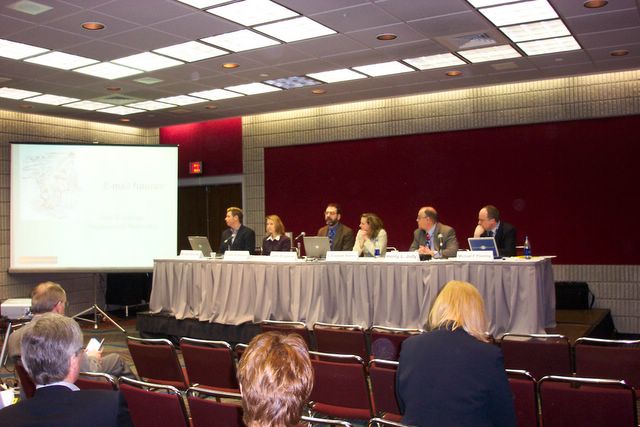
Elizabeth Bowles, Chair of the Working Group on Spam and Unsolicited Electronic Marketing, led the CLE program on Saturday morning concerning Spam technologies and how they can lead to under-appreciated legal implications.
Program materials are available here (ABA membership required). A copy of the program slides can be found here. A copy of the Complaint filed in the Ambrogi suit mentioned during the presentation can be found here.
Joining Elizabeth were:
- Michael F. Fleming, Attorney, (a/k/a your humble reporter), Larkin Hoffman Daly & Lindgren Ltd., Minneapolis, MN
- Henry L. (Hank) Judy, Of Counsel, Kirkpatrick & Lockhart Nicholson Graham, LLP, Washington, D.C.,
- John R. Levine, Principal, Taughannock Networks, Trumansburg, NY
- Colleen B. Robbins, Staff Attorney, Federal Trade Commission, Marketing Practices, Washington, D.C.,
- Michael Spooner, Senior Market Analyst, Vircom, Montreal, Quebec, Canada
Finally, Hank and Michael made the jump from the technologies to the practice of law -- what presumptions of fact should we drop, what strategies can we implement? Hank primarily concentrated on the single biggest problem that e-mail inherently has (that it's always had, but which is made worse with the growth in the use of spam filtering technology) -- Did it get there in the first place? If so, when? What evidence might we have to show that it did? Michael went through a contract-based strategy that might be used where parties to a communication have strong need for proving receipt or the like (see the materials!) -- and then made clear that all of this strategy presumes that the parties have, one way or the other, been willing to cooperate with each other outside of the e-mail system alone. None of the contract strategy means a thing in a transaction that is purely e-mail based.
Saturday, April 02, 2005
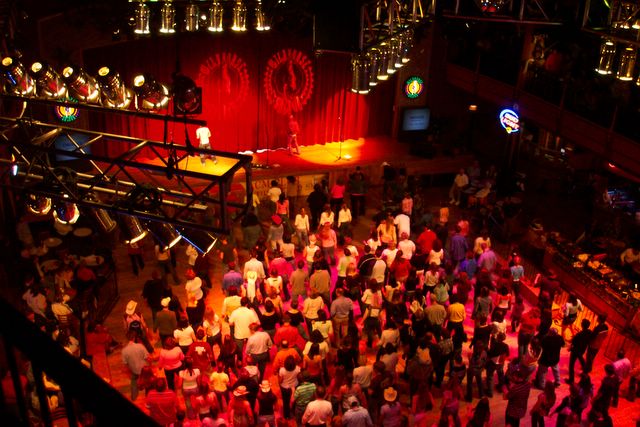
Committee Dinner at the Wildhorse Saloon -- A Wild Time for All
Plenary Session of Cyberspace

The plenary meeting was well attended, despite the lack of chairs.
Rapt Attention 
Cyberspace Lawyers Meet Reality Again
After the Gun Fight 
Elizabeth, Elaine and John
Global Jurisdiction and e-Commerce Subcommittee
John Gregory reported on the Global Jurisdiction Subcommittee's meeting:
The Global Jurisdiction and e-Commerce Subcommittee met on Friday April 1st. It discussed five main topics: five related to possible programs at the annual or other meetings, and one work project.
Hal also brought to the meeting the prospect that the Organization of American States would adopt a project to develop harmonized rules on consumer protection in e-commerce. Hal circulated a uniform provision on such jurisdiction adopted last year by the Uniform Law Conference of Canada, and an FTC proposal on money transactions. If the OAS does adopt such a project, there would be a role for a working group of this subcommittee in analysing documents and possibly making submissions on that work.
It was also noted that Hal's international policy working group would meet with the International Coordinating Committee of the Section on Saturday. Any last minute proposals for change to the UNCITRAL e-communication Convention would be welcome at that meeting.
[After the meeting there was an expression of interest in jurisdiction questions generally and an inquiry as to the follow-up, if any, to the jurisdiction work of Michael Geist's subcommittee reported on in 2004. This would be the subject of online and offline discussion to be reported to the subcommittee through the usual electronic channels.]
The Global Jurisdiction and e-Commerce Subcommittee met on Friday April 1st. It discussed five main topics: five related to possible programs at the annual or other meetings, and one work project.
- At the Winter Working Meeting, the subcommittee had developed ideas on the fate of online consumer contracts faced with foreign law. Brad Joslove of Paris had presented a Hot Topics item today as a foretaste of the program. The subcommittee maintained its sponsorship of this proposal, in conjunction with the Consumer Protection working group. Brad had developed materials that would be the basis of what would be made available at the CLE session. There was some discussion of what other countries' laws should be represented at such a session. The UK and Canada were proposed - leaving open whether adding others would be confusing or helpful, notably Latin American jurisdictions.
- Also at the WWM, there had been discussion of a program developed out of Roland Trope's Checkpoints in Cyberspace book, which had now been published. This aimed at international business transactions and the risks that doing business electronically either created or aggravated in such matters. A co-sponsorship with the International Law Section was probably desirable on the point.
- The other Hot Topic today was Roland Trope and Michael Power's presentation on directors' duties of data governance: privacy, information security, and related issues. Judging from the reception of the presentation, there was considerable interest in pursuing the topic at greater depth. Michael and Roland were publishing a book with the ABA on the topic, expected to be available by the annual meeting. This was thought not to overlap with the prior topic, since this one was more domestically focused (though international considerations were not irrelevant) and not aimed at transactions.
- Irwin Schwartz suggested some work on protection of copyright online, based on some of his experience in dealing with hackers and unauthorized publishers of proprietary web content. This involved a number of other subcommittee and possibly committees or even sections, but seemed likely to involve more issues than just the file-sharing that was attracting headlines. It was not clear whether the international aspects of the topic were sufficient to justify primary carriage by this subcommittee, but there was some recognition that a topic should be developed and members of this subcommittee would be invited to help out.
- Hal Burman promoted the idea of a "recent developments" topic for a presentation. Some international features would include the new (July 2005) UNCITRAL convention on the use of electronic communications in international contracts. Recent case law could also be mentioned - even the AOL France case that Brad had spoken to, and Google's recent (mis)adventures with French trade mark law. This topic was developed further at the general leadership meeting of the Committee. No specific responsibilities were assigned at this meeting.
Hal also brought to the meeting the prospect that the Organization of American States would adopt a project to develop harmonized rules on consumer protection in e-commerce. Hal circulated a uniform provision on such jurisdiction adopted last year by the Uniform Law Conference of Canada, and an FTC proposal on money transactions. If the OAS does adopt such a project, there would be a role for a working group of this subcommittee in analysing documents and possibly making submissions on that work.
It was also noted that Hal's international policy working group would meet with the International Coordinating Committee of the Section on Saturday. Any last minute proposals for change to the UNCITRAL e-communication Convention would be welcome at that meeting.
[After the meeting there was an expression of interest in jurisdiction questions generally and an inquiry as to the follow-up, if any, to the jurisdiction work of Michael Geist's subcommittee reported on in 2004. This would be the subject of online and offline discussion to be reported to the subcommittee through the usual electronic channels.]
Ecommerce Subcommittee
Elaine Ziff from Skadden, Arps, Slate, Meagher & Flom, NYC, and Chair of the Subcommittee, gives us the following report:
The Ecommerce Subcommittee met on Friday afternoon and considered two projects. The first, proposed by Cris Kunz and Philip Schmandt, is to prepare a "Model Electronic Data Agreement" with commentary. Picking up where the Model Trading Partner Agreement leaves off, the Model Electronic Data Agreement could potentially form the basis for standardizing the agreements between trading partners and their third party data processors. Currently, the number of vendors providing value-added data transmission and management services, and the disparity of contract forms, results in the expenditure of time and effort by trading partners attempting to harmonize the arrangements between their respective middlemen. If standardization could be achieved, it would streamline this process. An outline of key terms in existing data agreements was presented by Hank Judy, to stimulate discussion.
The second project discussed was safeselling.org. This would be an ABA sponsored free- access website devoted to providing information on the common questions of entrepreneurs launching an on-line venture. The site would cover such topics as domain names, payment methods, taxation, terms and conditions, privacy, and security, in an FAQ format directed primarily at non-lawyers. The paradigm for this project is safeshopping.org, a currently-operating ABA-sponsored website which provides tips to consumers regarding on-line shopping.
The Safeselling project is headed by Jon Rubens and co-sponsored by the ABA Small Business Committee. It is gaining momentum, with five sections of content already drafted. It is anticipated that, between now and the Annual Meeting in August, more content sections will be generated and circulated to the appropriate Subcommittees and Working Groups for their input.
The Ecommerce Subcommittee met on Friday afternoon and considered two projects. The first, proposed by Cris Kunz and Philip Schmandt, is to prepare a "Model Electronic Data Agreement" with commentary. Picking up where the Model Trading Partner Agreement leaves off, the Model Electronic Data Agreement could potentially form the basis for standardizing the agreements between trading partners and their third party data processors. Currently, the number of vendors providing value-added data transmission and management services, and the disparity of contract forms, results in the expenditure of time and effort by trading partners attempting to harmonize the arrangements between their respective middlemen. If standardization could be achieved, it would streamline this process. An outline of key terms in existing data agreements was presented by Hank Judy, to stimulate discussion.
The second project discussed was safeselling.org. This would be an ABA sponsored free- access website devoted to providing information on the common questions of entrepreneurs launching an on-line venture. The site would cover such topics as domain names, payment methods, taxation, terms and conditions, privacy, and security, in an FAQ format directed primarily at non-lawyers. The paradigm for this project is safeshopping.org, a currently-operating ABA-sponsored website which provides tips to consumers regarding on-line shopping.
The Safeselling project is headed by Jon Rubens and co-sponsored by the ABA Small Business Committee. It is gaining momentum, with five sections of content already drafted. It is anticipated that, between now and the Annual Meeting in August, more content sections will be generated and circulated to the appropriate Subcommittees and Working Groups for their input.
Subscribe to:
Posts (Atom)
