We're going to have an informal gathering for dinner tonight. Elizabeth Bowles and her husband recommended a Cuban restaurant on California St. they ate at the other night. We're probably going to try that restaurant. Meet in the lobby of the Sheraton at 6:30.
Saturday, January 29, 2005


An example of the Bayes Principle in Action
From the Wired article mentioned below. This sums it up pretty well:
In the language of statistics, Bayes' theorem relates phenomena observed in the present (the evidence) to phenomena known to have occurred in the past (the prior) and ideas about what is going to happen (the model). Mathematically, the formula is represented as
P(yt)P(t)
P(ty) = --------------
P(y)
For nonmathematicians, understanding the implications of the theorem without recourse to real-world metaphors is difficult. So imagine a short-order cook working in a busy café. In a din of conversation, clattering plates, and street noise, the waiters dash by the kitchen counter, shouting orders. What a customer actually ordered is t in the above equation. The garble the cook hears is y. A Bayesian decision process would allow the beleaguered chef to send out as many correct orders as possible.
He has some prior knowledge: Few customers order the smothered duck feet, while the steak frites is a perennial favorite. The cook can use information like this to calculate the prior probability that a given dish was ordered: P(t), or the probability of t. He also knows that one waiter tends to mispronounce any dish with a French name, that a bus roars past the restaurant every 10 minutes, and that the sizzling sounds from the skillets can obscure the difference between, say, ham and lamb. Taking these factors into account, he creates a complicated model of ways the orders might get confused: P(yt), the probability of y, given t. Bayes' theorem allows the chef to chain the probabilities of all possible influences on what he hears to calculate the probability, P(ty), that the order he heard was for the dish the customer chose.
It's pretty easy to see how this type of model could be helpful in constructing an application that could learn what's Spam and what's not Spam.
In the language of statistics, Bayes' theorem relates phenomena observed in the present (the evidence) to phenomena known to have occurred in the past (the prior) and ideas about what is going to happen (the model). Mathematically, the formula is represented as
P(yt)P(t)
P(ty) = --------------
P(y)
For nonmathematicians, understanding the implications of the theorem without recourse to real-world metaphors is difficult. So imagine a short-order cook working in a busy café. In a din of conversation, clattering plates, and street noise, the waiters dash by the kitchen counter, shouting orders. What a customer actually ordered is t in the above equation. The garble the cook hears is y. A Bayesian decision process would allow the beleaguered chef to send out as many correct orders as possible.
He has some prior knowledge: Few customers order the smothered duck feet, while the steak frites is a perennial favorite. The cook can use information like this to calculate the prior probability that a given dish was ordered: P(t), or the probability of t. He also knows that one waiter tends to mispronounce any dish with a French name, that a bus roars past the restaurant every 10 minutes, and that the sizzling sounds from the skillets can obscure the difference between, say, ham and lamb. Taking these factors into account, he creates a complicated model of ways the orders might get confused: P(yt), the probability of y, given t. Bayes' theorem allows the chef to chain the probabilities of all possible influences on what he hears to calculate the probability, P(ty), that the order he heard was for the dish the customer chose.
It's pretty easy to see how this type of model could be helpful in constructing an application that could learn what's Spam and what's not Spam.
Who's This Guy Bayes Anyway?
At the SPAM working group, we spent a few minutes discussing the difference between a Turing Test and a Baysian filter. Here are some background articles that might be helpful.
The Quest for Meaning
In 2000, Wired Magazine ran a great article on the efforts of a UK company called Autonomy and how they were using the ideas of Reverend Thomas Bayes to build a next generation tool to extract meaning from unstructured text data. It's a good article.

The Turing Test
Snipped from http://cogsci.ucsd.edu/~asaygin/tt/ttest.html#intro. The Turing Test was introduced by Alan M. Turing (1912-1954) as "the imitation game" in his 1950 article (now available online) Computing Machinery and Intelligence (Mind, Vol. 59, No. 236, pp. 433-460) which he so boldly began by the following sentence:
I propose to consider the question "Can machines think?" This should begin with definitions of the meaning of the terms "machine" and "think."
Turing Test is meant to determine if a computer program has intelligence.
Many Spam Filters use a challenge response system to weed out automatically generated email messages. They respond with a challenge that can only be met by a human, thus defeating automated email programs that generate Spam.

The Quest for Meaning
In 2000, Wired Magazine ran a great article on the efforts of a UK company called Autonomy and how they were using the ideas of Reverend Thomas Bayes to build a next generation tool to extract meaning from unstructured text data. It's a good article.
The Turing Test
Snipped from http://cogsci.ucsd.edu/~asaygin/tt/ttest.html#intro. The Turing Test was introduced by Alan M. Turing (1912-1954) as "the imitation game" in his 1950 article (now available online) Computing Machinery and Intelligence (Mind, Vol. 59, No. 236, pp. 433-460) which he so boldly began by the following sentence:
I propose to consider the question "Can machines think?" This should begin with definitions of the meaning of the terms "machine" and "think."
Turing Test is meant to determine if a computer program has intelligence.
Many Spam Filters use a challenge response system to weed out automatically generated email messages. They respond with a challenge that can only be met by a human, thus defeating automated email programs that generate Spam.
Survey Ideas
By brainstorming with several of the members of different Subcommittees we've devised the following list of topic ideas for the Survey. Please add to the list. The general idea is to create Survey articles this year that a more broad than they are deep and that provide general business law practitioners with an update on developments in key areas of Cyberspace Law. Space is limited, and we'll need to narrow down the field quite a bit.
See me to talk about these topics.
Internet Law
See me to talk about these topics.
Internet Law
- eDiscovery developments (Zubulake and new federal rules of ediscovery)
- J. Westermeier's (sp?) Computer Law Roundup
- Internet Taxation (Moratorium extension and state taxation of Internet sales of goods)
- EU Tax issues Electronic Voting
Privacy and Security
- Disposal rules for consumer data (SEC, FTC, FDIC)
- FACTA
- State Roundup (e.g. California update on the new mandatory disclosure of security threats, SB1, etc.)
- RFID (passport technology, Walmart, etc.)
- FBI Abandoning Carnivore
- Phishing
- Case on ECPA (transient memory)
- HIPAA Security Regs
Financial Services Issues
- Check 21
- Electronic payment systems
- Phishing
- Fin Srvcs patents
Intellectual Property
- File Sharing (Grokster, Bittorrent)
- Jay Monahan speech
- Adware/Spyware update
CAIT
- Spam Updates (German decision, Suits and criminal prosecutions,
- Regulatory landscape for VOIP
- Technology export
- Electronic monitoring of employees
- Advertising issues (?)
International
- UNCITRAL developments
- Recent defamation claims in UK; competitors
- Arrest of Amazon guy in India
- EU Data Privacy Developments (Set 2 of Model clauses, Work Group decisions)
- EU Taxes
Friday, January 28, 2005
Global Jurisdiction and e-Commerce Subcommittee
The Internet Jurisdiction and Global eCommerce group met on Friday, January 28. 

The group discussed several topics, and John Gregory has produced a very detailed account of their activities. To review the detailed notes, you can access the summary here. The topics included:

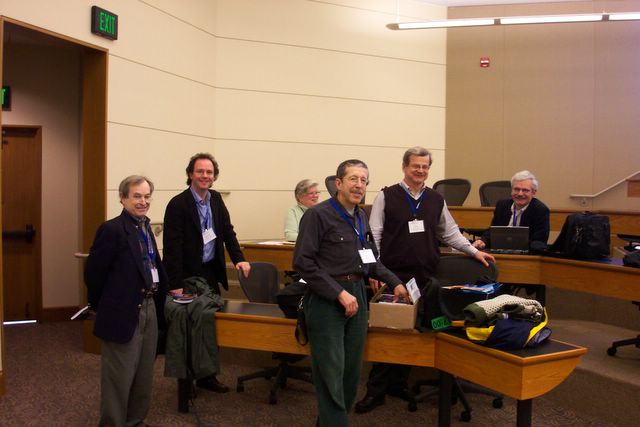
The group discussed several topics, and John Gregory has produced a very detailed account of their activities. To review the detailed notes, you can access the summary here. The topics included:
- Cross-border investment transactions – risks and solutions
- Developments in the law relating to jurisdiction
- VoIP – international regulation
Internet Law Explores the Esoterica and Risks of Using Email for Formal Communications
The Internet Law Subcommittee had a very well-attended meeting that included a lot of heat and light. Hank started the meeting with a description of a general problem--that there are numerous technological barriers to using email for formal communications--and launching a discussion of how to deal with the problem.
The list of technical problems included:
The list of technical problems included:
- Filtering technologies that deal with spyware, adware, and spam
- Blacklists of certain mailservers
- Companies that require outgoing spam filters (recipients or recipients domains must be on a "whitelist")
- Anti-virus software
- Proposed changes
- Firewalls
- Technology that ads "signatures" or "footers" to outgoing email messages that state the email can't form a contract
The group then explored the impact of these technological barriers in the following contexts:
- Contract formation
- Notices of termination, default, etc.
- Court filings
- Ethical obligations to inform clients of certain events
- Communications with co-counsel
Some of the solutions (a start on a list of best practices) the group identified included:
- contract clauses that email is never an acceptable form of notice
- contract clauses that override the presumptions in UETA and require acknowledgement of emails (but what does "acknowledgement mean? Does my "Out of Office" message constitute acknowledgement?)
- use of technologies (like Web Bugs) to track receipt
The group also pondered several other issues:
- Is UETA already outdated on this subject?
- Can we describe these issues by creating a continuum of communciations that are more or less suitable to email as the means of transmission?
- How significantly business people rely on email for all of their communications and how they are very reluctant to do anything in paper form (who has envelopes anymore?)
This discussion will likely blossom into a program idea.
Open Group and Transferable Records and Connectivity Join Forces
The Open Group joined with the Transferable Records group and the Connectivity group to discuss common issues. The Open Group gave an interesting presentation on their current and recent efforts. [A copy of the slides will be posted here soon!]
The discussion led quickly to the technology and legal intersections that are being dealt with in the transferable records (and electronic chattel paper) world. Many ideas -- few authoritative conclusions. Oops -- we don't even know what Authoritative means.
And so it goes...
The discussion led quickly to the technology and legal intersections that are being dealt with in the transferable records (and electronic chattel paper) world. Many ideas -- few authoritative conclusions. Oops -- we don't even know what Authoritative means.
And so it goes...
Spring Meeting Deadlines
The ABA Business Law Section Spring Meeting is scheduled for March 31 to April 3rd in Nashville, TN.
Please note the following deadlines:
February 11
Early Registration
February 16
Materials Deadline
March 8
Hotel Registration Deadline
March 11
Advance Registration and Refund Deadline
March 18
Program materials available on the Web
The February 16 Materials Deadline is really a DEAD line. Talk to John Lunseth if you have questions about your materials.
Please note the following deadlines:
February 11
Early Registration
February 16
Materials Deadline
March 8
Hotel Registration Deadline
March 11
Advance Registration and Refund Deadline
March 18
Program materials available on the Web
The February 16 Materials Deadline is really a DEAD line. Talk to John Lunseth if you have questions about your materials.
ABA Cyberspace Intellectual Property Subcommittee
ABA Cyberspace Law Committee
Friday afternoon we will be jumpstarting our "open source" project and perhaps refocusing it or combining forces with other subcommittees and working groups.
Saturday morning co-chairs Eric Goldman and John Ottaviani will discuss their "top 10" Cyberspace IP decisions of 2004, with a number of honorable mentions. Mark Lemley and Jay Monahan touched on a number of these in their presentations Friday morning.
The remainder of the time Friday and Saturday will be spent brainstorming potential new projects and sending people off to start working on them.
Feel free to join us in Room 272!
Friday afternoon we will be jumpstarting our "open source" project and perhaps refocusing it or combining forces with other subcommittees and working groups.
Saturday morning co-chairs Eric Goldman and John Ottaviani will discuss their "top 10" Cyberspace IP decisions of 2004, with a number of honorable mentions. Mark Lemley and Jay Monahan touched on a number of these in their presentations Friday morning.
The remainder of the time Friday and Saturday will be spent brainstorming potential new projects and sending people off to start working on them.
Feel free to join us in Room 272!
Vince Polley speaks at the Opening Plenary

Vince Polley -- Grand PooBah of the Committee, speaks to the plenary session of the CLCC WWM on January 28, 2005
Vince pointed out that membership continues to grow -- we are currently at 1660 listed members in the Committee, an increase of 20% over the last year.

Candace Jones then updated us on the committee's primary information repository on all of our various and sundry project -- the "MATRIX." (No, not the Matrix.) She reminded all of the group leaders that they MUST get updates on their respective matrix entries to her regularly and quickly after the meetings. Please help us in this regard, because the Project Matrix is one of our primary resources when recruiting new members.
Subscribe to:
Posts (Atom)
