Sunday, April 03, 2005
LawCasting with Podcast
Robert Ambrogi's LawSites reports on a new service called Blawgcast where they provide one-stop browsing for law-related Pod and Vlog casts. Check it out. If you don't know what a podcast is, read Robert Ambrogi's LawSite's Technology News article, Podcasting: CLE's New Wave?


CLE Program: Spam-Fighting Technologies and Their Legal Implications
UPDATED WITH MATERIALS
The Saturday Morning Panel

Elizabeth Bowles, Chair of the Working Group on Spam and Unsolicited Electronic Marketing, led the CLE program on Saturday morning concerning Spam technologies and how they can lead to under-appreciated legal implications.
Program materials are available here (ABA membership required). A copy of the program slides can be found here. A copy of the Complaint filed in the Ambrogi suit mentioned during the presentation can be found here.
Joining Elizabeth were:
Finally, Hank and Michael made the jump from the technologies to the practice of law -- what presumptions of fact should we drop, what strategies can we implement? Hank primarily concentrated on the single biggest problem that e-mail inherently has (that it's always had, but which is made worse with the growth in the use of spam filtering technology) -- Did it get there in the first place? If so, when? What evidence might we have to show that it did? Michael went through a contract-based strategy that might be used where parties to a communication have strong need for proving receipt or the like (see the materials!) -- and then made clear that all of this strategy presumes that the parties have, one way or the other, been willing to cooperate with each other outside of the e-mail system alone. None of the contract strategy means a thing in a transaction that is purely e-mail based.
The Saturday Morning Panel

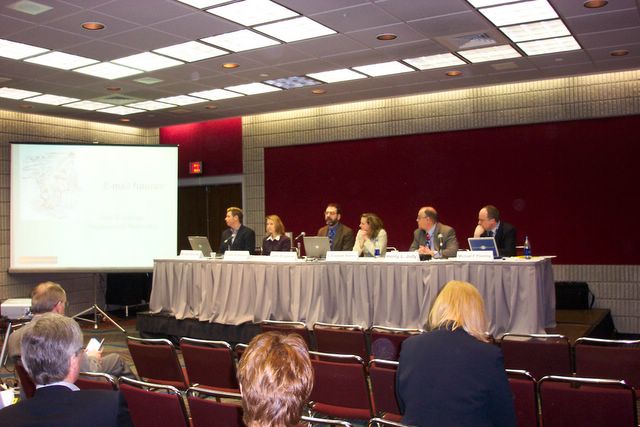
Elizabeth Bowles, Chair of the Working Group on Spam and Unsolicited Electronic Marketing, led the CLE program on Saturday morning concerning Spam technologies and how they can lead to under-appreciated legal implications.
Program materials are available here (ABA membership required). A copy of the program slides can be found here. A copy of the Complaint filed in the Ambrogi suit mentioned during the presentation can be found here.
Joining Elizabeth were:
- Michael F. Fleming, Attorney, (a/k/a your humble reporter), Larkin Hoffman Daly & Lindgren Ltd., Minneapolis, MN
- Henry L. (Hank) Judy, Of Counsel, Kirkpatrick & Lockhart Nicholson Graham, LLP, Washington, D.C.,
- John R. Levine, Principal, Taughannock Networks, Trumansburg, NY
- Colleen B. Robbins, Staff Attorney, Federal Trade Commission, Marketing Practices, Washington, D.C.,
- Michael Spooner, Senior Market Analyst, Vircom, Montreal, Quebec, Canada
Finally, Hank and Michael made the jump from the technologies to the practice of law -- what presumptions of fact should we drop, what strategies can we implement? Hank primarily concentrated on the single biggest problem that e-mail inherently has (that it's always had, but which is made worse with the growth in the use of spam filtering technology) -- Did it get there in the first place? If so, when? What evidence might we have to show that it did? Michael went through a contract-based strategy that might be used where parties to a communication have strong need for proving receipt or the like (see the materials!) -- and then made clear that all of this strategy presumes that the parties have, one way or the other, been willing to cooperate with each other outside of the e-mail system alone. None of the contract strategy means a thing in a transaction that is purely e-mail based.
Saturday, April 02, 2005
Committee Dinner at the Wildhorse Saloon -- A Wild Time for All
Plenary Session of Cyberspace


The plenary meeting was well attended, despite the lack of chairs.
Rapt Attention 
Cyberspace Lawyers Meet Reality Again
After the Gun Fight 
Elizabeth, Elaine and John
Global Jurisdiction and e-Commerce Subcommittee
John Gregory reported on the Global Jurisdiction Subcommittee's meeting:
The Global Jurisdiction and e-Commerce Subcommittee met on Friday April 1st. It discussed five main topics: five related to possible programs at the annual or other meetings, and one work project.
Hal also brought to the meeting the prospect that the Organization of American States would adopt a project to develop harmonized rules on consumer protection in e-commerce. Hal circulated a uniform provision on such jurisdiction adopted last year by the Uniform Law Conference of Canada, and an FTC proposal on money transactions. If the OAS does adopt such a project, there would be a role for a working group of this subcommittee in analysing documents and possibly making submissions on that work.
It was also noted that Hal's international policy working group would meet with the International Coordinating Committee of the Section on Saturday. Any last minute proposals for change to the UNCITRAL e-communication Convention would be welcome at that meeting.
[After the meeting there was an expression of interest in jurisdiction questions generally and an inquiry as to the follow-up, if any, to the jurisdiction work of Michael Geist's subcommittee reported on in 2004. This would be the subject of online and offline discussion to be reported to the subcommittee through the usual electronic channels.]
The Global Jurisdiction and e-Commerce Subcommittee met on Friday April 1st. It discussed five main topics: five related to possible programs at the annual or other meetings, and one work project.
- At the Winter Working Meeting, the subcommittee had developed ideas on the fate of online consumer contracts faced with foreign law. Brad Joslove of Paris had presented a Hot Topics item today as a foretaste of the program. The subcommittee maintained its sponsorship of this proposal, in conjunction with the Consumer Protection working group. Brad had developed materials that would be the basis of what would be made available at the CLE session. There was some discussion of what other countries' laws should be represented at such a session. The UK and Canada were proposed - leaving open whether adding others would be confusing or helpful, notably Latin American jurisdictions.
- Also at the WWM, there had been discussion of a program developed out of Roland Trope's Checkpoints in Cyberspace book, which had now been published. This aimed at international business transactions and the risks that doing business electronically either created or aggravated in such matters. A co-sponsorship with the International Law Section was probably desirable on the point.
- The other Hot Topic today was Roland Trope and Michael Power's presentation on directors' duties of data governance: privacy, information security, and related issues. Judging from the reception of the presentation, there was considerable interest in pursuing the topic at greater depth. Michael and Roland were publishing a book with the ABA on the topic, expected to be available by the annual meeting. This was thought not to overlap with the prior topic, since this one was more domestically focused (though international considerations were not irrelevant) and not aimed at transactions.
- Irwin Schwartz suggested some work on protection of copyright online, based on some of his experience in dealing with hackers and unauthorized publishers of proprietary web content. This involved a number of other subcommittee and possibly committees or even sections, but seemed likely to involve more issues than just the file-sharing that was attracting headlines. It was not clear whether the international aspects of the topic were sufficient to justify primary carriage by this subcommittee, but there was some recognition that a topic should be developed and members of this subcommittee would be invited to help out.
- Hal Burman promoted the idea of a "recent developments" topic for a presentation. Some international features would include the new (July 2005) UNCITRAL convention on the use of electronic communications in international contracts. Recent case law could also be mentioned - even the AOL France case that Brad had spoken to, and Google's recent (mis)adventures with French trade mark law. This topic was developed further at the general leadership meeting of the Committee. No specific responsibilities were assigned at this meeting.
Hal also brought to the meeting the prospect that the Organization of American States would adopt a project to develop harmonized rules on consumer protection in e-commerce. Hal circulated a uniform provision on such jurisdiction adopted last year by the Uniform Law Conference of Canada, and an FTC proposal on money transactions. If the OAS does adopt such a project, there would be a role for a working group of this subcommittee in analysing documents and possibly making submissions on that work.
It was also noted that Hal's international policy working group would meet with the International Coordinating Committee of the Section on Saturday. Any last minute proposals for change to the UNCITRAL e-communication Convention would be welcome at that meeting.
[After the meeting there was an expression of interest in jurisdiction questions generally and an inquiry as to the follow-up, if any, to the jurisdiction work of Michael Geist's subcommittee reported on in 2004. This would be the subject of online and offline discussion to be reported to the subcommittee through the usual electronic channels.]
Ecommerce Subcommittee
Elaine Ziff from Skadden, Arps, Slate, Meagher & Flom, NYC, and Chair of the Subcommittee, gives us the following report:
The Ecommerce Subcommittee met on Friday afternoon and considered two projects. The first, proposed by Cris Kunz and Philip Schmandt, is to prepare a "Model Electronic Data Agreement" with commentary. Picking up where the Model Trading Partner Agreement leaves off, the Model Electronic Data Agreement could potentially form the basis for standardizing the agreements between trading partners and their third party data processors. Currently, the number of vendors providing value-added data transmission and management services, and the disparity of contract forms, results in the expenditure of time and effort by trading partners attempting to harmonize the arrangements between their respective middlemen. If standardization could be achieved, it would streamline this process. An outline of key terms in existing data agreements was presented by Hank Judy, to stimulate discussion.
The second project discussed was safeselling.org. This would be an ABA sponsored free- access website devoted to providing information on the common questions of entrepreneurs launching an on-line venture. The site would cover such topics as domain names, payment methods, taxation, terms and conditions, privacy, and security, in an FAQ format directed primarily at non-lawyers. The paradigm for this project is safeshopping.org, a currently-operating ABA-sponsored website which provides tips to consumers regarding on-line shopping.
The Safeselling project is headed by Jon Rubens and co-sponsored by the ABA Small Business Committee. It is gaining momentum, with five sections of content already drafted. It is anticipated that, between now and the Annual Meeting in August, more content sections will be generated and circulated to the appropriate Subcommittees and Working Groups for their input.
The Ecommerce Subcommittee met on Friday afternoon and considered two projects. The first, proposed by Cris Kunz and Philip Schmandt, is to prepare a "Model Electronic Data Agreement" with commentary. Picking up where the Model Trading Partner Agreement leaves off, the Model Electronic Data Agreement could potentially form the basis for standardizing the agreements between trading partners and their third party data processors. Currently, the number of vendors providing value-added data transmission and management services, and the disparity of contract forms, results in the expenditure of time and effort by trading partners attempting to harmonize the arrangements between their respective middlemen. If standardization could be achieved, it would streamline this process. An outline of key terms in existing data agreements was presented by Hank Judy, to stimulate discussion.
The second project discussed was safeselling.org. This would be an ABA sponsored free- access website devoted to providing information on the common questions of entrepreneurs launching an on-line venture. The site would cover such topics as domain names, payment methods, taxation, terms and conditions, privacy, and security, in an FAQ format directed primarily at non-lawyers. The paradigm for this project is safeshopping.org, a currently-operating ABA-sponsored website which provides tips to consumers regarding on-line shopping.
The Safeselling project is headed by Jon Rubens and co-sponsored by the ABA Small Business Committee. It is gaining momentum, with five sections of content already drafted. It is anticipated that, between now and the Annual Meeting in August, more content sections will be generated and circulated to the appropriate Subcommittees and Working Groups for their input.
Working Group on Electronic Payment Systems
The major project of this group is publication of a matrix of electronic payments products. This project is a joint project with the Banking Law subcommittee of the UCC committee and is ongoing. We are committed to speaking this week to work out how to get the existing matrix to publication, and to keep it updated regularly on an ongoing basis.
The primary participants from the UCC Payments group: Marina Adams, Stephanie Heller, Paul Turner and Steve Veltri. Bob Ledig and Sarah Jane Hughes contribute from the Cyberspace Law Committee. If you would to discuss the project, or discuss other issues with the WG, please contact Sarah at sjhughes (a) indiana.edu.
The primary participants from the UCC Payments group: Marina Adams, Stephanie Heller, Paul Turner and Steve Veltri. Bob Ledig and Sarah Jane Hughes contribute from the Cyberspace Law Committee. If you would to discuss the project, or discuss other issues with the WG, please contact Sarah at sjhughes (a) indiana.edu.
CAIT Subcommittee Meeting
Don Cohn and Michael Fleming chaired the meeting of the Corporate Aspects of Information Technology subcommittee. The group discussed the upcoming projects for the Spam and Unsolicited Electronic Marketing Working Group, and then began solicitations for new projects. At this point, the group is primarily looking for members who are interested in using one of the following ideas as a springboard for a project, and asks that if you would be interested in taking on leadership of any such project that you get in touch with either Don (donald.a.cohn (a) usa.dupont.com) or Michael (michael.f.fleming (a) gmail.com).
- Corporate Risk Analysis: Corporate legal practitioners have long experienced difficulty in matching the risk language of the law to the practices of business. Either the language and concepts of the law are viewed as esoteric 'legal issues' instead of important business concerns, or the risks are expressed in seemingly non-quantifiable forms such as "likely." The project would be to create a framework for one or both of those problems--one that would assist the lawyer in talking contract risk with the client in a way the client will appreciate. This project might either lend itself to a CLE presentation down the road, or an article at the magazine level (Business Law Today).
- Form Software Developer Agreement: It has been sometime (if ever?) since the Committee has issued a plain vanilla software development form agreement -- one which would have both a license element as well as a professional services element. An annotated agreement, which incorporates up-to-date thinking on some of the issues, and explores the negotiating points, would be helpful to many, particularly if it takes into account the diversity of client bases that this Committee's lawyers represent. Done well, with the right amount of substance, this would lend itself well to a book treatment combined with a CD Rom -- or may ultimately be part of a series of forms that this subcommittee and others in the CLC are working on (such as the form Web developer agreement being worked on by another subcommittee).
- Electronic Discovery Monographs: Most of the literature on electronic discovery is written to the litigators -- we feel that there is a lack of material written specifically with the in-house corporate counsel in mind. Rather than dealing with the lawsuit that has already happened, the in-house lawyer is in a better position to practice preventative medicine. Plus, when a problem occurs, the in-house lawyer who is savvy to electronic discovery issues can often provide valuable strategy to the outside lawyer who is less familiar with the company. We envision a series of 3-4 monographs -- 20 pagers or thereabout -- each talking about a particular slice of the e-discovery world. For example, we envision a monograph dedicated to the concept of litigation holds -- the practices that a company must undertake should litigation become likely. Such a monograph should discuss both preparations that might be done well before the problems arise, the costs that will need to be addressed, and how to institute a panic button should it become necessary. Since this project should lead to 3-4 related but different monographs, it lends itself to having a group of 3-4 drafters, each of whom could take an equal role in producing their own monograph, and together they would edit and produce a series of works. This might be publishable as a small book, or could be a candidate for an electronic distribution such as an e-book?
- Information Technology Danger Points in Divestitures: While there is no lack of generalized checklists that M&A practitioners might use in their deals, many of those checklists miss some of the IT-specific tricky points and how to resolve them. For example, if a divested subsidiary is the holder of a patent that is being used by the parent, how should the problems be raised, analyzed, negotiated and resolved? This should not be an attempt to re-write those things that have already been written, but rather it should concentrate on those things that are specific to our member's daily practices, distilling some of those things that we have saved our corporate colleagues from tripping on. A magazine article treatment is probably the best initial treatment for this.
Friday, April 01, 2005
Meanwhile, Back on the Official Site
Props to Jim Frey and his co-horts at the ABA, who have done an outstanding job of putting the Spring Meeting schedule online.
So what you say? That's been done for years, right?
Not so fast, pardner. Look here at the interactive version. The schedule is now organized so you can look up by date, by Committee, or just limited to CLE programs. As you page through the programs, you can find full descriptions and the like, as well as links to the PDF files with the written materials where appropriate.
Best of all -- the thing is now updated in (essentially) real time. The paper slips with the changes to the meetings? No longer needed (although they continue to be posted). You can always check in and see what's next, and if the meeting has been changed, you'll see it online. There's even a section for cancelled meetings, which is updated as news arrives during the meeting.
What's next? I suggest the guys get to work on MYABAMEETING.com -- No longer will I need to transpose the sessions I want to attend from a paper book over to my computer calendar -- I'd like it to help me put together an itinerary for my days at the meeting (pointing out conflicts and the like), and then once I've figured it out, I could upload it all to my computer's calendar and/or phone and/or whatever. And, of course, if any changes occur in my chosen meetings, the thing would buzz my phone to let me know.
(I can dream, can't I?)
In the meantime, outstanding work guys and gals at the Association! Thanks!
So what you say? That's been done for years, right?
Not so fast, pardner. Look here at the interactive version. The schedule is now organized so you can look up by date, by Committee, or just limited to CLE programs. As you page through the programs, you can find full descriptions and the like, as well as links to the PDF files with the written materials where appropriate.
Best of all -- the thing is now updated in (essentially) real time. The paper slips with the changes to the meetings? No longer needed (although they continue to be posted). You can always check in and see what's next, and if the meeting has been changed, you'll see it online. There's even a section for cancelled meetings, which is updated as news arrives during the meeting.
What's next? I suggest the guys get to work on MYABAMEETING.com -- No longer will I need to transpose the sessions I want to attend from a paper book over to my computer calendar -- I'd like it to help me put together an itinerary for my days at the meeting (pointing out conflicts and the like), and then once I've figured it out, I could upload it all to my computer's calendar and/or phone and/or whatever. And, of course, if any changes occur in my chosen meetings, the thing would buzz my phone to let me know.
(I can dream, can't I?)
In the meantime, outstanding work guys and gals at the Association! Thanks!
Google Ups Storage Limits
Wow! Google increased storage limits for GMAIL to something they're calling infinity+1. Check it out.
The Well Turns 20
The Committee's friend Declan McCullagh posts an article on CNET today about the 20th Birthday of The Well. For those of you who aren't familiar with the Well, it was a very influential and very early force in the growth and development of the thing we all know of as the Internet.
Check out the story on CNET and an interesting account about the creation of the Well on the Well itself.
Check out the story on CNET and an interesting account about the creation of the Well on the Well itself.
Subscribe to:
Posts (Atom)
